Sunday, 1 February 2015

Pattachitra


We move to the heritage and craft rich state of Odisha for this post. Wonderful weaves (ikat, bomkai), silks (Berhampur) and crafts (pipli patch work) dot this region. Yet another handicraft that Odisha is famous for is the Pattachitra - literally translating to drawing (chitra) on a canvas (patta).

Made originally on canvas using naturally obtained dyes and brushes, this has slowly moved to other mediums also such as palm leaf and cloth. On a green palm frond, the art work is generally done with a nail. When it dries, the exposed portion become black and looks like ink work on palm leaf. This is known as Tala-Chitra or palm leaf paintings. Generally the paintings conveyed mythological stories like the Ramayana or the zodiac calendar or the Puri deities - Jagannatha, Balabhadra and Subhadra.
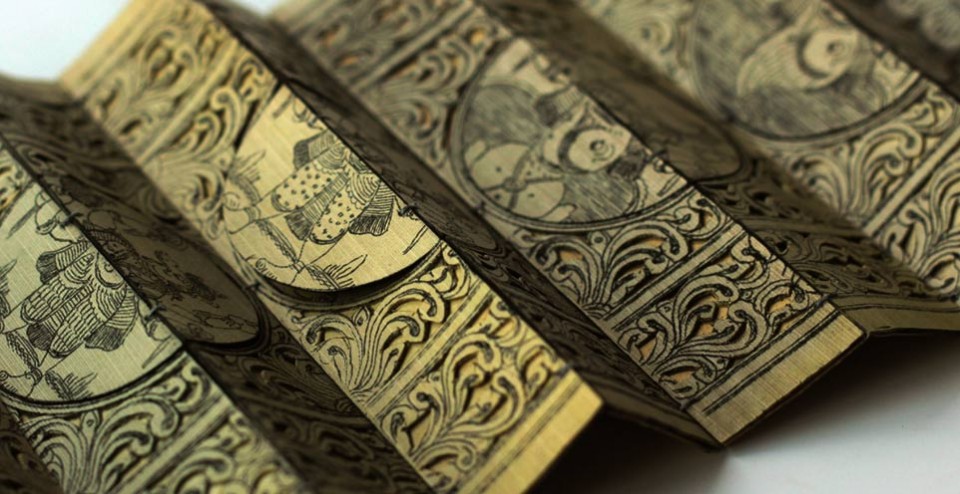
Image Courtesy - gaatha.com

Slowly from canvas, it also moved to other forms of textile to spread the craft and for sustenance. The dyes used continue to be made from natural substances and hence there isn't much variety in color. Prominently used colors are red, black and white. The cloth has to be light so as to not absorb too much of the paint as well as to aid in the free movement of the brushes. So pattachitra work is generally done on Tussar silk. The only downside to this is that it creases very easily (as can be seen in some pictures :()!!

Mine is a lovely pistachio green tussar with tribal art pattachitra. It was purchased in Bhubaneshwar. While the borders are lined with huts and humans, the body has an interesting array of every day activities! This reminded me so much of the Warli art which is predominantly done in white color, once again depicting scenes from everyday life.

Pattachitra tussar silk

The pallu is a grand depiction of life in a village and a few pictures are required to showcase the vibrant pictures that have been hand painted so elegantly in just 2 colors - black and red.

Pattachitra tussar silk
The lovely pallu


Here is a closeup of some of the elements of the left and right panels.

Pattachitra tussar silk

This is the middle panel and if you look closely you will see the concentric circles that have been drawn to make sure that the paintings form a pattern perfectly!!!

Pattachitra tussar silk
Paintings derived from village scenes


Wednesday, 31 December 2014

Bandhani or Bandhini

Bandhani is our own indigenous tie and dye method from the states of Rajasthan and Gujarat. Bhandhna ( बाँधना ) means 'to tie' and hence the name bandhani for this craft form. It is a simple craft form where in the areas that need to resist the dye are covered (by tying with strings) and the fabric then dyed. This results in spectacular patterns that are unique and cannot be replicated perfectly. Here is a crepe silk from Gujarat that has varying shades of blue due to the bleeding of colors in the washing process, but the inner patterns remain white. This was purchased at Pothys a decade ago.

Badhani Crepe Silk
Bandhani Crepe Silk
People from the Saurashtra region who migrated to the Madurai region during the Nayak period carried this craft form with them. The base color of the fabric is generally white or beige so as to let the pattern show through in the end product. The design is imprinted on the fabric and then the knots are tied (to resist the dye) as required to form a pattern and finally the cloth is dyed. Remove the threads and viola! You have a unique final product!!!

Bandhani
Bandhani - 1) Tied fabric 2) String removed 3) Fabric pressed to reveal pattern 4) Final product


I picked up this Bandhani cotton saree from Madurai. It has a chevron pattern pallu and a concentric circle pattern in the body with hand embroidery.

Bandhani
Bandhani Pallu of a Cotton Saree

Bandhani
 Body of the Cotton Saree which has Bandhani Pattern with embroidery done

 
As you can see, this is a labour intensive process as each knot has to be tied with hand. The more the number of knots, the more labour intensive it is and hence the price is also high. This has led to a decline in this craft form as patronage is low.The Crafts Council of India is working towards preserving this craft form.

A poor and cheap imitation of this art form is the local cousin Sungudi, for which Madurai is widely known.  This is created using screen printing method where in the pattern is created for the width of the saree and is printed repeatedly for the length of the saree. This is a Ranee Sungudi that I picked up from a recent Madurai trip - fell for the color combination!


Sungudi Saree
Sungudi Saree
Wishing my (very few) readers a very happy, healthy and prosperous 2015!

Sunday, 30 November 2014

The Kalakshetra Saree

Created and popularized by Rukmini Devi Arundale, the saree gets its name from the ubiquitous institution founded by her. This is a Kancheepuram silk saree weaved at the craft center in the institution premises in Thiruvanmiyur. Today, the center also supports the dying craft of Kalamkari. 

Kalakshetra Saree
Kalakshetra Saree

The uniqueness of the saree is it's simplicity. There is no jari work in the body, border or pallu of the saree, only thread work.

Kalakshetra Saree
The Pallu
Though there are many variants available these days, the saree featured here is an original. It is my mother's and was purchased at the Khadi showroom in Neyveli 3 decades ago. It has the original design of butta (filled dots) in the body and the rudraksha (ருத்ராக்ஷ) in the border. The workmanship is amazing - the front and back of the designs are so beautifully interlocking.

Kalakshetra Saree
Close up of the Rudraksha
 After many hand washes, it is so soft and cozy to wear!


Wednesday, 5 November 2014

Thirubhuvanam Silk

Thirubhuvanam is a small town near Kumbakonam, very famous for it's weaving cluster and the Kambaheswarar (aka) Sarabeswarar Temple. We visited this temple during a temple trip to Kumbakonam, mainly to purchase a local silk saree! The temple is very lovely and the Goddess Dharmasamvardhini has a separate shrine.


Kambaheswarar/Sarabeswarar Thirubhuvanam
Kambaheswarar/Sarabeswarar Temple, Thirubhuvanam


Couple of noteworthy points in this temple:
  • The foresight in the construction of temples in olden days - temples are places of refuge in times of war, floods or any calamity. That is the reason for the many entrances (the four gopurams generally found in temples). In this temple, the sanctum is elevated and reachable by steps. This is done mainly to give shelter to people in case of floods.
  • Another neat feature I found is the waterways or கால்வாய் found in the temple.All the water that is used to bathe the deities and the sanctum are piped to a holding tank which then connects to waterways that go the periphery of the temple, where it joins other passageways of the temple and is diverted to the temple gardens. And we talk about rain harvesting & water conservation these days!
Kambaheswarar/Sarabeswarar Temple, Thirubhuvanam
Kambaheswarar/Sarabeswarar Temple Water Conservation System, Thirubhuvanam


And right on Sannadhi Street (the name generally given to the main street emanating from a temple entrance) are the numerous silk saree shops!! My diwali sari this year (2014) was a purchase from ThiCo silks (Thirubhuvanam Cooperative Society) on Sannidhi Street. It is a beautiful coffee brown with onion pink border. I paired it with a brocade blouse in pink and gold!

Thirubhuvanam Silk
Thirubhuvanam Silk

Thirubhuvanam silks have the GI status and are made from locally grown domesticated silkworms. What is unique about the saree is the way in which they are folded. The fold is narrow and if unfurled and wrapped correctly, the folds can form the front pleats of the saree. This way it retains the fold for a long time and is preferred by brides to get that perfect look on their wedding day!

Sunday, 5 October 2014

Valkalam

Valkalam sarees are just like the Jamdani. They come with interwoven pallu and borders with exquisite thread work. They are created both in cotton and silk weaves, especially Benares sarees. Mine is a valkalam on Coimbatore cotton in a lovely grey with black thread work. I will let the pictures do all the talking ....


Valkalam Cotton
Valkalam Saree Pallu and Body/Border

Valkalam Cotton
Detail in the Valkalam Pallu


Monday, 22 September 2014

Narayanpet Saree

This is a saree from the town of Narayanpet in Andhra Pradesh (now Telengana), a state with a rich heritage of weaves. Though the Narayanpet saree is not as well known as the Pochampally or Gadwal, it is very unique and distinguished by certain special characteristics.

Narayanpet Cotton
Generally, the border is of a different color than the body and the border has thread/jari work in a set pattern. It is a 2/3 line weave of ||*||*||*|| separated by a gap and a repeat of the same number of lines of work to form the border. Spilling into the body is always the temple design.

Narayanpet Cotton
Narayanpet Cotton


Being in the Western part of the state and due to proximity to Karnataka and Maharashtra, the Narayanpet saree is widely available in those 2 states. Mine were picked up in Dadar (Mumbai) on a recent trip. This lovely powder blue and grey beauty is a cotton saree and has yet another trademark of the Narayanpet saree - the checks. The weave is smooth and the saree is light and carries very easily.

I also picked up this black and white checks - was love at first sight! Saw many other sarees and came back to this one :) It is very simple with the traditional Narayanpet border.


Narayanpet Cotton

A more traditional Narayanpet is the green and mustard saree on the right that I picked up for my mother. Photographed is the pallu while the body is a full green.

Sunday, 7 September 2014

Pattern! Pattern! What pattern do you choose?

OLD IS GOLD! What my daughter is wearing below is something i wore a quarter century ago (oh my! how old does that make me?). It has found it's way into this post for a specific reason - due to the numerous patterns in a single piece of silk! This is a traditional South Indian Paavadai (long skirt) which is worn with a blouse.

It was purchased at ThiCo (Thirubhuvanam Cooperative Silk Society) in Neyveli, where I grew up. The color is a beautiful Kanakambaram - the color of the crossandra flower!


Thirubuvanam Silk
Pattu Paavadai & the Kankambaram poo (photo courtesy: wiki)


This long skirt has 6 different patterns:
  1. Rettai pattai (ரெட்டை பட்டை) - literally meaning two strips
  2. Chakkaram (சக்கரம்) or wheel pattern
  3. Spear or eetti (ஈட்டி) pattern
  4. checks
  5. Veldhaari (வேல்தாரி) - a typical pattern of curves with dots in between
  6. Butta ( புட்டா) or filled circles

Thirubhuvanam Silk Skirt
Lovely patterns

Unique weaving patterns such as these are a treasure and these days (circa 2014) due to modernization and mechanization, the charm and beauty of owning something so intricate and elegant is close to impossible. Yes, they are exorbitantly priced, and even if you are ready to pay, you may not be able to own it because they are not available now. Yes, old is truly gold!

So, what pattern do you choose???